










|
Joint Navy F/A-18 Testing at
Benefield Anechoic Facility Complete
|
|
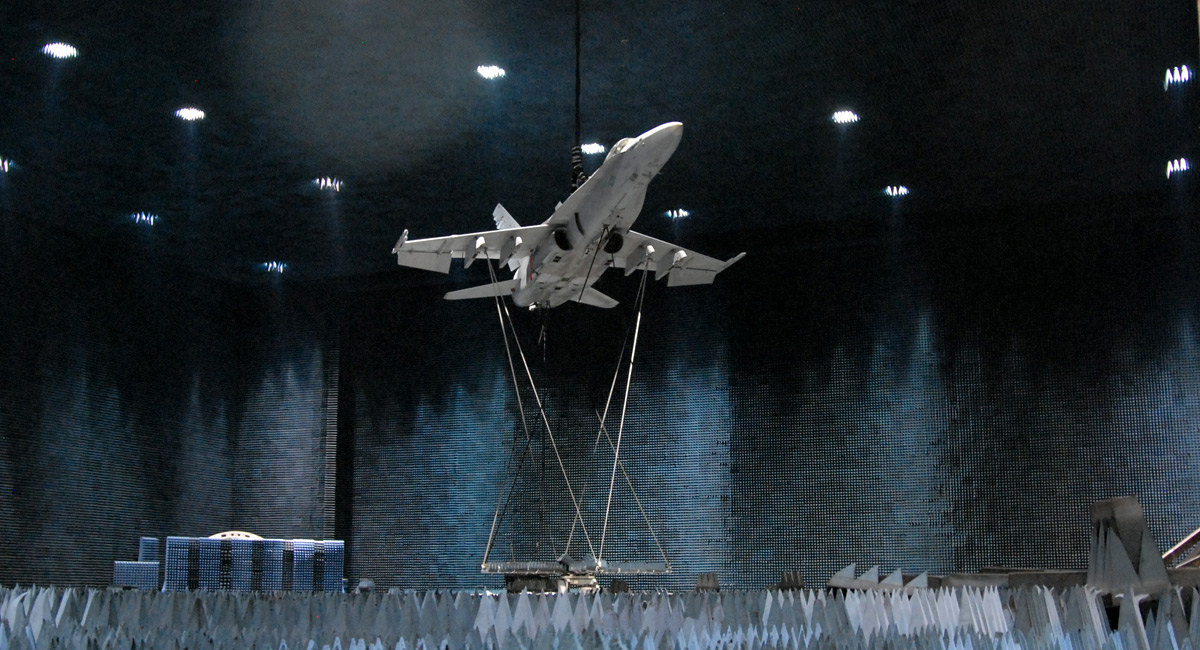
3/11/2009 - EDWARDS AIR FORCE BASE, Calif. -- The 772nd Test Squadron teamed up with Naval Air Weapons Station China Lake in a joint effort to complete antenna pattern testing on a Navy F/A-18C Hornet at the Benefield Anechoic Facility at Edwards on Jan. 22. The purpose of the antenna test is to evaluate how the entire F/A-18C system affects the antenna's pattern and what parts of the aircraft can significantly change the pattern. "We are trying to discover the areas at which the radar is working properly," said 1st Lt. Christopher Stilson, 772nd TS test engineer. "When building an antenna, it is designed as a standalone system. Once installed on an aircraft a lot of the structure of the aircraft will affect how the antenna operates." For this test, the team evaluated the installed antenna pattern by having the F/A-18C Hornet in the anechoic chamber and measuring the performance of the radar while it was installed on the aircraft. "This would be the most accurate that the testers can get, more accurate than measuring the antenna itself," said Lt. Col. Taylor Selden, 772nd TS commander. "It represents what the pilot would really encounter for performance when flying operationally." To test this system, the test team disconnected the aircraft radar from the power source, transmitted energy in from an outside source and measured the power received on the back end of the antenna. "For that we needed a very quiet, isolated environment, and that was what the chamber provided," Colonel Selden said. "It allowed us an opportunity to get more accurate measurement." The Benefield Anechoic Facility's size, the largest in the Department of Defense, allowed the testers to evaluate all the aircraft's radar at various distances and angles. This enabled them to capture 384 individual test points. "We were able to perform the full antenna pattern test with greater distance between our transmit antenna and the aircraft," Lieutenant Stilson said. "The team also set up four different antenna transmitters to give us different locations and angles to the aircraft." The antenna pattern measurement data will enable the Navy to design a software model of the F/A-18C's antenna pattern, Colonel Selden said. As a result of this testing, the Navy will be able to simulate what the F/A-18C's radar performance will be for a given scenario prior to flight. Colonel Selden said this is the first time the U.S. Navy tested tested in the BAF. Hopefully, it will be the first of many opportunities with other services and really make this a "full Department of Defense facility." "The working environment is really great," the colonel said. "It was a small cohesive team and they were able to quickly go from start to finish for this project. We have a really good outcome. We are happy to help out the Navy to provide them the data they needed so they can better understand what their capabilities are." Source: USAF Press Release by Senior Airman Julius Delos Reyes |
|
|
All original content Copyright © 2006 - 2008 The North Spin