










|
Boeing 777 Freighter Makes First
Flight
|
|
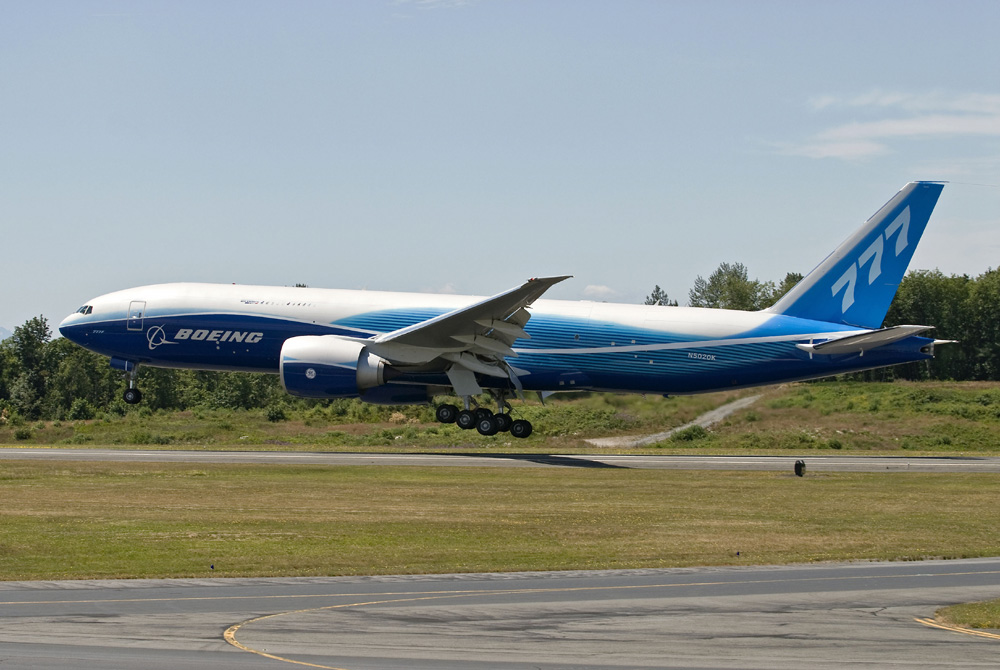
7/14/2008 - EVERETT, WA -- The first Boeing 777 Freighter, the world's most capable twin-engine cargo airplane, today successfully took to the sky for the first time and completed an initial series of tests during a flight lasting more than three-and-a-half hours. The airplane performed well. "The 777 Freighter completed the scheduled three-hour inaugural flight with no airplane performance-related issues," said Dennis O'Donoghue, vice president of Flight Operations, Test & Validation. "The only issue was a data-communication problem between the airplane and the telemetry room at Boeing Field." Boeing will identify and fix the problem to resume the flight test program as soon as possible. Due to the data-transmission issue, the 777 Freighter was unable to complete all of the first-flight tests and was returned to Paine Field in Everett, Wash. per Federal Aviation Administration procedure. The original first-flight plan called for a landing at Boeing Field. The newest member of the 777 airplane family took off at 10 a.m. (PDT) from Paine Field in Everett, Wash. It landed at 1:38 p.m. at Paine Field. During today's flight, 777 Chief Pilot Suzanna Darcy-Hennemann and 777 Deputy Chief Pilot Van Chaney took the airplane to an altitude of 18,000 feet (5,486 meters) and an air speed of 270 knots, or about 311 miles (500 kilometers) per hour, customary on a first flight. Typically, the 777s cruise altitude is 35,000 (10,668 meters), and its cruise speed is Mach 0.84, about 484 miles (779 kilometers) per hour. "This is the moment that thousands of Boeing employees have worked towards in the design, build and test of the 777 Freighter. The airplane handled perfectly," said Darcy-Hennemann after the flight ended. "Being at the controls of a commercial airplane on its maiden flight is a rare and unique opportunity and it was a great day." The 777 Freighter, the sixth member of the 777 airplane family, will be capable of flying 4,885 nautical miles (9,047 km) with a full payload, making it the world's longest-range twin-engine freighter. The airplane's range capability will translate into significant savings for cargo operators: fewer stops and associated landing feeds, less congestion at transfer hubs, lower cargo handling costs and shorter cargo delivery times. "I'm very proud of our 777 team and what they've accomplished with this airplane," said Larry Loftis, vice president 777 program, Boeing Commercial Airplanes. "By working together with our customers and suppliers we have built the best possible new cargo airplane. I couldn't be more pleased." The flight-test program will involve the airplane flown today and a second one. The two aircraft will prove the airplane's safety, reliability and service-ready condition during approximately 270 flight hours and more than 450 ground test hours. Boeing's plan is to earn certification from the U.S. Federal Aviation Administration and Europe's Joint Aviation Authority during the fourth quarter and deliver to launch customer Air France shortly thereafter. To date, Boeing has secured 78 firm orders from 11 customers for the 777 Freighter. Source: Boeing Press Release |
|
|
All original content Copyright © 2006 - 2008 The North Spin