










|
NASA / Northrop Agreement Opens
Door to Science Investigation
|
|
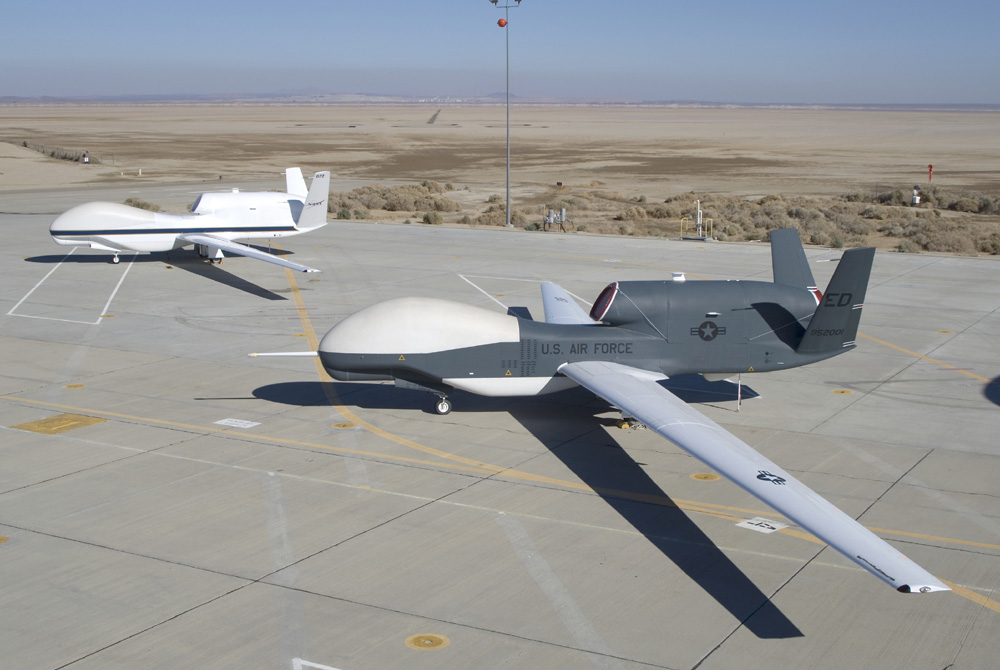
5/15/2008 - EDWARDS, CA -- NASA’s Dryden Flight Research Center and the Northrop Grumman Corporation have reached an agreement that will enable NASA's Science Mission Directorate to conduct Earth science research with the Northrop Grumman-developed RQ-4 Global Hawk unmanned aircraft system. Under a Space Act Agreement signed April 30, NASA and Northrop Grumman will bring to flight in 2009 two pre-production Global Hawk aircraft that were recently transferred to NASA. Northrop Grumman will share in their use to conduct its own flight demonstrations for expanded markets, missions and airborne capabilities, including integration of unmanned aircraft systems into the national airspace. The two Global Hawk aircraft, among the first seven built during the original Defense Advanced Research Projects Agency sponsored Advanced Concept Technology Demonstration program, were transferred to NASA Dryden from the U.S. Air Force in September 2007. NASA acquired the two aircraft for research activities supporting its Airborne Science Program. “This innovative partnership not only provides for the activation of the Global Hawk flight operations at NASA Dryden, but also sets the stage for an exciting future of collaborative science missions and technology experiments,” said Kevin L. Petersen, NASA Dryden director. "The capabilities of this platform are unique and will provide NASA and Northrop Grumman some exceptional opportunities to advance technology and science through flight." As the world’s first fully autonomous, high-altitude, long-endurance unmanned aircraft system, Global Hawk can fly up to 65,000 feet for more than 31 hours at a time. The aircraft have a range of 11,000 nautical miles. Its endurance and exceptional range allow for a non-stop flight from Dryden in Southern California to the North Pole with a seven-hour loiter period before returning. To date, Global Hawks have flown more than 22,000 hours in military service with the Air Force. The primary NASA sponsor is the Earth Science Division of the Science Mission Directorate. The division is developing plans to capitalize on the extreme range and dwell time of the Global Hawk for atmospheric chemistry and radiation science missions in addition to hurricane research. "We are looking forward to working with our National Oceanic and Atmospheric Administration and Department of Energy partners to explore the unique capabilities of the Global Hawk to augment the current satellite and aircraft based observation systems NASA uses," adds Dr. Michael Freilich, NASA's Earth Science Division director, NASA Headquarters in Washington. Global Hawk also has many potential applications in addition to the advancement of science, including development of disaster support capabilities and development of advanced unmanned aircraft systems technologies. In October 2007, Air Force Global Hawks were used to monitor wildfires in Southern California. "Global Hawk's range, endurance and altitude make it particularly suited to a broad range of applications," said Corey Moore, sector vice president of Advanced Concepts and Integrated Solutions for Northrop Grumman. "Access to these two flight test vehicles will allow us to more fully explore new potential missions for this remarkable system." Source: NASA Dryden Press Release |
|
|
All original content Copyright © 2006 - 2008 The North Spin