










|
Boeing Successfully Flies Fuel
Cell-Powered Airplane
|
|
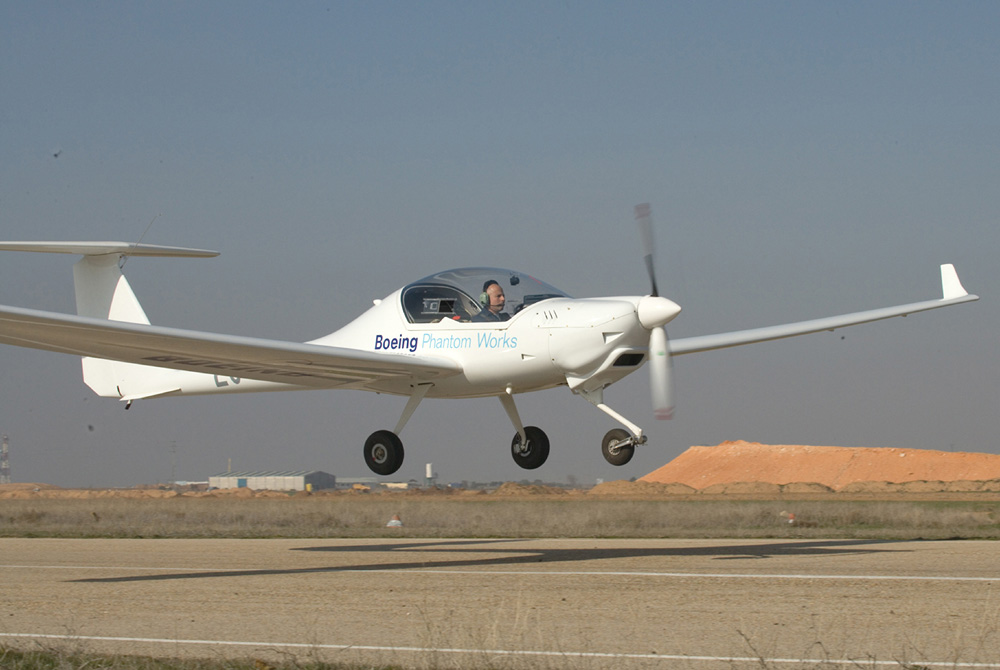
4/3/2008 - MADRID, Spain -- Boeing announced today that it has, for the first time in aviation history, flown a manned airplane powered by hydrogen fuel cells. The recent milestone is the work of an engineering team at Boeing Research & Technology Europe (BR&TE) in Madrid, with assistance from industry partners in Austria, France, Germany, Spain, the United Kingdom and the United States. "Boeing is actively working to develop new technologies for environmentally progressive aerospace products," said Francisco Escarti, BR&TE's managing director. "We are proud of our pioneering work during the past five years on the Fuel Cell Demonstrator Airplane project. It is a tangible example of how we are exploring future leaps in environmental performance, as well as a credit to the talents and innovative spirit of our team." A fuel cell is an electrochemical device that converts hydrogen directly into electricity and heat with none of the products of combustion such as carbon dioxide. Other than heat, water is its only exhaust. A two-seat Dimona motor-glider with a 16.3 meter (53.5 foot) wingspan was used as the airframe. Built by Diamond Aircraft Industries of Austria, it was modified by BR&TE to include a Proton Exchange Membrane (PEM) fuel cell/lithium-ion battery hybrid system to power an electric motor coupled to a conventional propeller. Three test flights took place in February and March at the airfield in Ocaña, south of Madrid, operated by the Spanish company SENASA. During the flights, the pilot of the experimental airplane climbed to an altitude of 1,000 meters (3,300 feet) above sea level using a combination of battery power and power generated by hydrogen fuel cells. Then, after reaching the cruise altitude and disconnecting the batteries, the pilot flew straight and level at a cruising speed of 100 kilometers per hour (62 miles per hour) for approximately 20 minutes on power solely generated by the fuel cells. According to Boeing researchers, PEM fuel cell technology potentially could power small manned and unmanned air vehicles. Over the longer term, solid oxide fuel cells could be applied to secondary power-generating systems, such as auxiliary power units for large commercial airplanes. Boeing does not envision that fuel cells will ever provide primary power for large passenger airplanes, but the company will continue to investigate their potential, as well as other sustainable alternative fuel and energy sources that improve environmental performance. BR&TE, part of the Boeing Phantom Works advanced R&D unit, has worked closely with Boeing Commercial Airplanes and a network of partners since 2003 to design, assemble and fly the experimental craft. Source: Boeing Press Release |
|
|
All original content Copyright © 2006 - 2008 The North Spin