










|
Boeing Completes Flight of First
AEW&C Wedgetail Modified in Australia
|
|
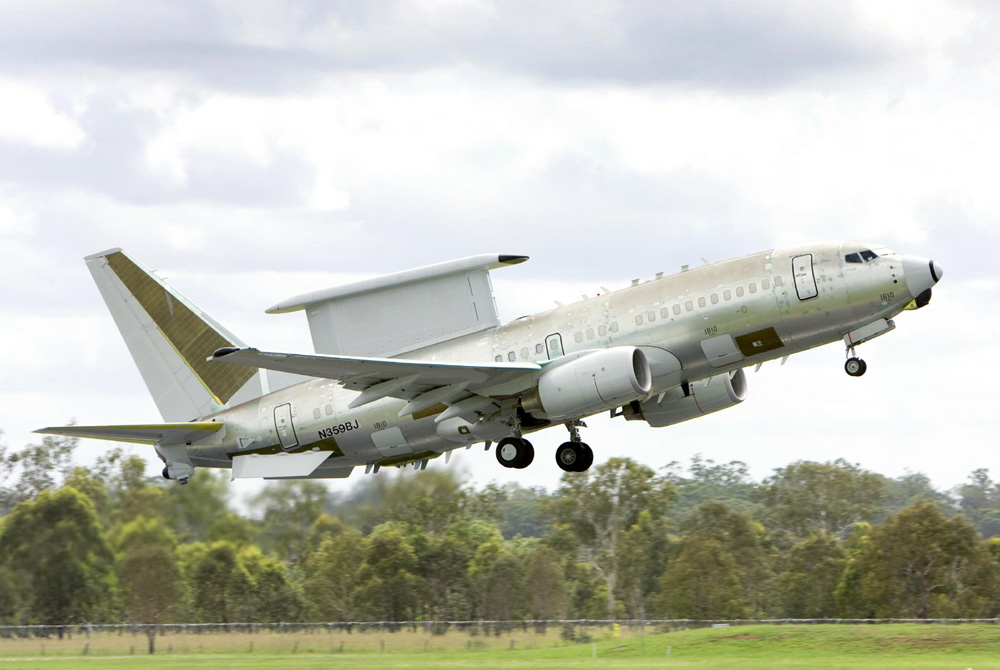
1/23/2008 - ST. LOUIS -- The Boeing Company has conducted a successful functional check flight of the first 737 Airborne Early Warning and Control (AEW&C) aircraft modified in Australia for Project Wedgetail. During the two-and-one-half hour flight Jan.23 from Royal Australian Air Force Base Amberley, Australia, pilot Regis Hancock and first officer Randon Stewart performed a series of functional tests that verified the airworthiness of the aircraft's systems and structures. The flight followed major aircraft modifications performed by Boeing Australia Limited at Amberley, including the installation and checkout of an advanced Multi-role Electronically Scanned Array (MESA) antenna, ventral fins and mission system equipment. "Aircraft No. 3 will undergo an additional mission functional check flight prior to returning Jan. 31 to Seattle, where it will begin a five-month development and type acceptance flight test program," said Scott March, Boeing Wedgetail program manager. The plane then will return to Australia to complete configuration updates and production acceptance testing prior to delivery. Boeing will deliver the first two Wedgetail aircraft in March 2009 and the remaining four aircraft by the end of 2009. "The flight is a tribute to the tremendous modification effort performed by Boeing Australia Limited employees. Project Wedgetail is the largest and most complex aircraft modification program ever undertaken in Australia," said David Withers, president of Boeing Australia Limited. "This project demonstrates Boeing Australia Limited as a regional leader in aircraft modifications and will increase the company's in-country technical capability for future large-scale projects." The Wedgetail program includes six 737 AEW&C aircraft plus ground support segments for mission crew training, mission support and system maintenance. Modification of four aircraft in Amberley is under way, with the first two completing modification in Seattle prior to entering the flight test program. The 737-700 features 21st century avionics, navigation equipment and flight deck features. Because of its advanced technology, the aircraft requires minimal downtime for maintenance. The 737 series has a worldwide base of suppliers, parts and support equipment. In addition to Northrop Grumman's MESA antenna with integrated identification friend-or-foe capabilities, the aircraft features a flexible, open architecture for cost-effective future upgrades, an extensive communications suite and aerial refueling capability. Source: Boeing Press Release |
|
|
All original content Copyright © 2006 - 2008 The North Spin