










|
C. Gordon Fullerton Makes Last
Flight with NASA
|
||
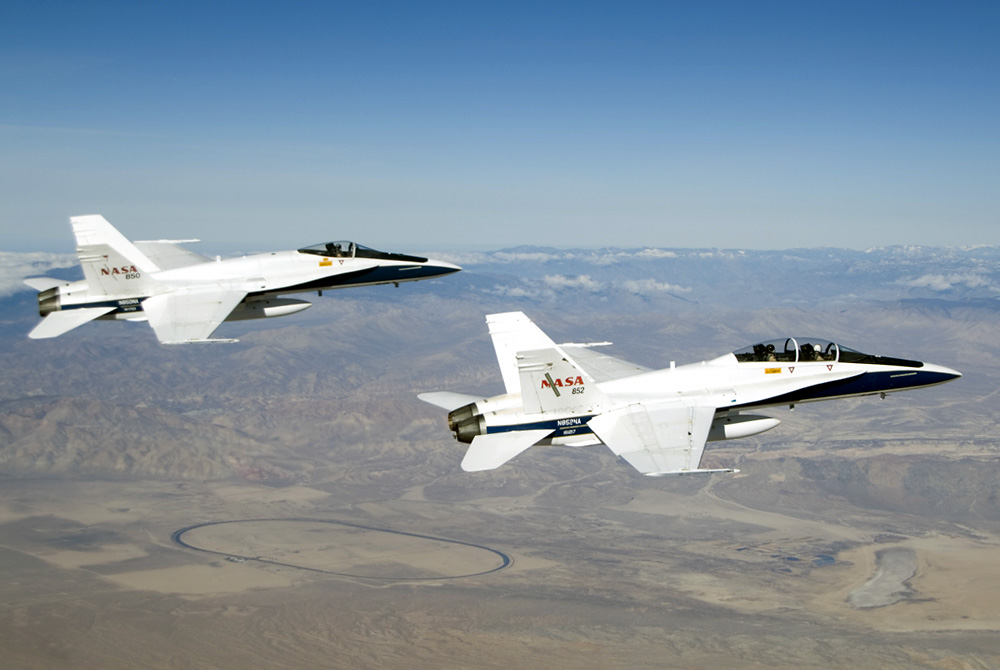
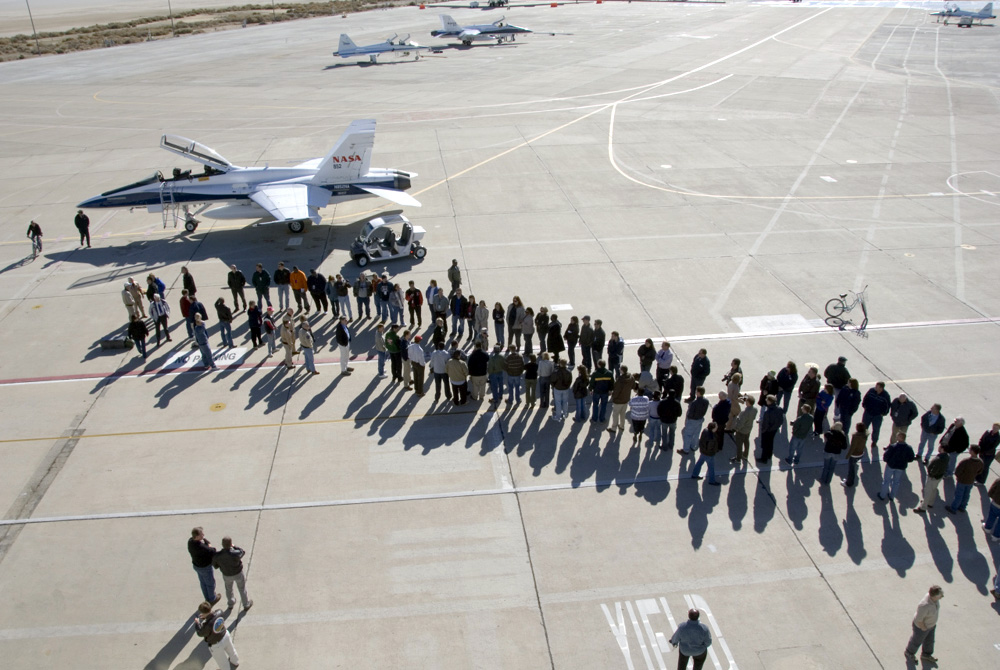
12/21/2007 - EDWARDS AIR FORCE BASE, CA --- Joined by Dryden research pilot Jim Smolka, 71 year old NASA Dryden research pilot and former astronaut C. Gordon Fullerton has ended 38 years with NASA, while making one last flight in F/A-18B #852 (161217). Also joined in the flight was F/A-18A #850 (161703) and one of the Dryden T-38Bs. After the flight, the formation made two low level passes over the Dryden complex before landing. As he taxied to the ramp, Fullerton was honored with the traditional twin arches of water, shot from Edwards Air Force Base fire trucks. Upon exiting the aircraft, he was greeted by his wife Marie and dozens of Dryden staff members. Fullerton began his aviation career with the US Air Force in 1958. Flying both fighters and bombers, he eventually studied at the US Aerospace Research Pilot School at Edwards and became a bomber test pilot. The Air Force then assigned him to NASA's astronaut corps in 1969, where he helped support the Apollo 14, 15, 16 and 17 lunar missions. He was also one of the pilots that flew the space shuttle prototype Enterprise during its landing test phase at Dryden. Next came his time in space during two early space shuttle missions, STS-3 on Columbia in 1982 and STS-51F on Challenger in 1985.
Leaving the astronaut corps in 1986, Fullerton would spend the next 21 years as a NASA research pilot. He was involved in many projects at Dryden, including the Propulsion Controlled Aircraft program, Space Shuttle high-speed landing tests, C-140 JetStar Laminar Flow Control, F-111 Mission Adaptive Wing, F-14 Variable Sweep Flow Transition, X-29 Vortex Flow Control, Russian Tu-144LL supersonic transport evaluation, and many others. He also spent time in the famous B-52B 'mother ship' #008 and also the DC-8 'Flying Lab'. Fullerton logged more than 16,000 flight hours in his career. His retirement from NASA became effective December 31, 2007.
Source: NASA Dryden |
|
|
All original content Copyright © 2006 - 2008 The North Spin