










|
China Lake Opens New Airstrip
for Unmanned Systems
|
|
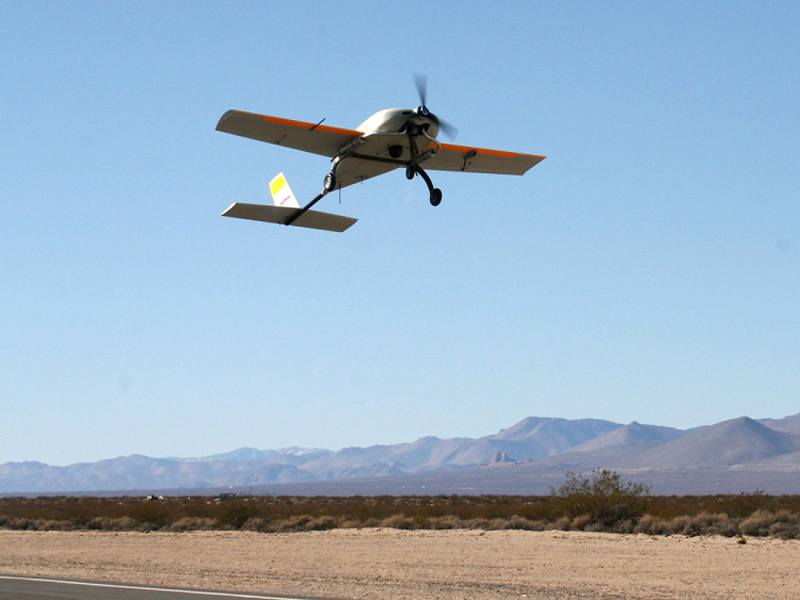
12/13/2007 - NAWCWD’s Unmanned Systems (US) Technical Project Office (TPO) inaugurated its new unmanned air systems (UAS) operations airstrip when two Raytheon Cobra unmanned air systems lifted off and flew missions at Naval Air Weapons Station China Lake on Dec. 13. “The importance of unmanned systems in the future of warfighting is increasing and China Lake provides an ideal atmosphere to develop and test emerging technologies,” said Michael Keeter, chief engineer in the US TPO. “These first flights with Cobra represent the first fruits of an enduring commitment by NAWCWD to support the weaponization and systems development of small UAS. What we do here in the future will lead to advancements in warfighting capabilities.” The US TPO is working to weaponize UAS already in existence, and to standardize the concepts, techniques, and integration of weapons, sensors, and targeting technologies that are related to weaponization of future unmanned systems. China Lake offers a great location for collaborating with a variety of companies as well as other government organizations whose goal is to connect weapons with smaller platforms, Keeter said. The US TPO currently has a Cooperative Research and Development Agreement in place with Raytheon. According to Raytheon officials, the Cobra UAS is just the first step in an evolutionary process. “Cobra is a test-platform for developing future UAS solutions that support future naval capabilities,” said Don Newman, Raytheon Missile Systems UAS program director. “It has a rugged and reliable airframe that allows us to integrate and test a variety of components to determine whether they advance the capability of new unmanned aircraft systems, such as the Killer Bee. For Raytheon, inaugurating the new airstrip at China Lake is a highly symbolic act that recognizes the importance of continuing to develop and test advanced new unmanned systems for the U.S. Navy.” The 2,200-by-50-foot asphalt airstrip located at Armitage Field is just one piece of the infrastructure at China Lake created to support the development of unmanned systems. The US TPO also has a state-of-the-art weaponization lab close to the ramp and has recently taken delivery of a mobile command and control lab that will be used to support both operations at the airstrip and remote operations. “We have a long legacy of skilled engineers at China Lake with vast amounts of experience in weapons related work across the kill chain,” said Andy Corzine, US TPO lead. “We’re taking that knowledge and the advancements in technology and applying it to small weapons on small platforms. Our geographical location and our unique range assets make China Lake a very UAS-friendly location. We’re going to take advantage of that and make some significant contributions to needed warfighting capabilities.” Source: USN Press Release By Renee Hatcher |
|
|
All original content Copyright © 2006 - 2008 The North Spin