










|
NASA and U.S. Forest Service
Partner on Wildfire Imaging Mission
|
||
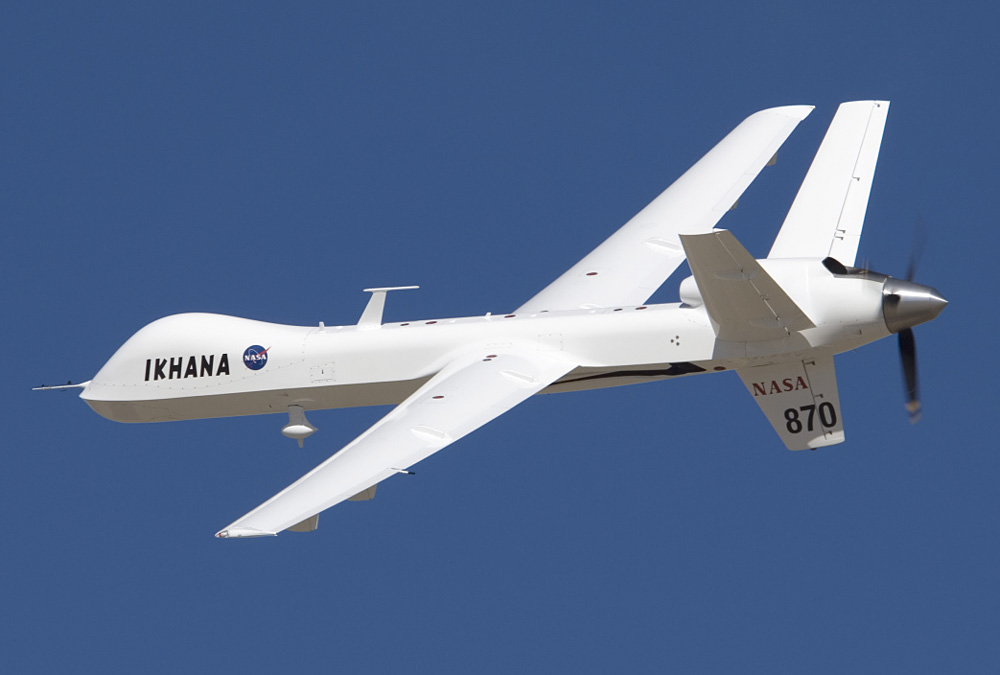
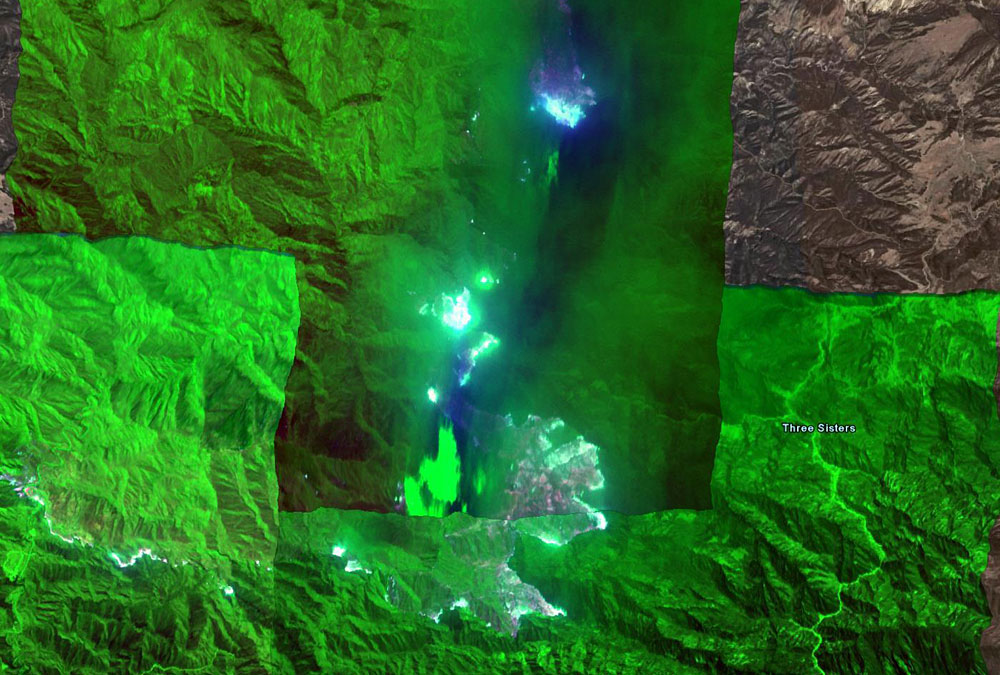
8/22/2007 - EDWARDS AIR FORCE BASE, CA. - The West Coast of the United States has suffered extreme heat and drought this summer, leading to greater danger of wildfires. NASA and the U.S. Forest Service are testing aerospace agency-developed technologies to improve wildfire imaging and mapping capabilities. From mid-August through September, NASA's Dryden Flight Research Center is conducting flights of a remotely piloted unmanned aircraft system to demonstrate the capabilities of its sophisticated new imaging and real-time communications equipment. The first flight of the series Aug. 16 captured images of California wildfires, including the Zaca Fire in Santa Barbara County. The aircraft carried instruments that collected data while flying more than 1,200 miles over a 10-hour period. "The images from the flight demonstrated that this technology has a future in helping us fight wildland fires," stated Zaca Incident Commander Mike Dietrich. "We could see little on the ground since the fire was generating a lot of smoke and burning in a very remote and inaccessible area. This technology captured images through the smoke and provided real time information on what the fire was doing," said Dietrich. "These tests are a ground-breaking effort to expand the use of unmanned aircraft systems in providing real-time images in an actual fire event," said Vincent Ambrosia, principal investigator of the Western States Fire Mission at NASA's Ames Research Center, Moffett Field, Calif. "This is a prime example of NASA science and technology being used to solve real-world problems." NASA's Ikhana, a Predator B remotely piloted aircraft adapted for civil missions, is flying its first operational effort during a series of four or five missions over the western states. Its sensor payload is collecting detailed thermal-infrared imagery of wildfires and is demonstrating the ability of unmanned aircraft systems to collect data continuously for 12 to 24 hours. The second flight in the series, a mission that will take Ikhana over Idaho and last an estimated 20 hours, is scheduled for Thursday, Aug. 23.
A satellite data link allows real-time transfer of fire imagery to virtually anywhere on Earth. Information from the sensor is transmitted to Ames where it is simultaneously available to the National Interagency Fire Center in Boise, Idaho, as a Google Earth overlay and through NASA/Open Geospatial Consortium Web services. "The success of these tests will help to refine the future direction of fire mapping for the wildfire management agencies," said Everett Hinkley, liaison and special projects group leader for the U.S. Forest Service, Salt Lake City. The Autonomous Modular Scanner sensor, designed and built at Ames, is currently configured to observe fires and other high-temperature sources. The scanner can detect temperature differences from less than one-half degree to approximately 1,000 degrees Fahrenheit. These temperature discrimination capabilities are important to improving fire mapping. Scientists are also testing the Collaborative Decision Environment software, a new technology application originally developed by NASA for the Mars Exploration Rovers. This software is an interactive tool that allows sharing of vast amounts of information with members of the mission team for effective planning and acquisition of imagery over critical fire events. Dryden completed a six-month process to obtain a Certificate of Authorization from the FAA allowing an unmanned aircraft to fly wildfire-sensing missions in the national air space of the western states. "In the not-too-distant future, we'll look back at unmanned aircraft demonstrations like the Western States Fire Mission and realize that these flights paved the way for civilian uses of unmanned aircraft that benefit all of us," said Brent Cobleigh, Ikhana project manager at NASA Dryden. The aircraft's name, Ikhana, is derived from a Native American Choctaw word that means intelligent, conscious or aware. NASA acquired the aircraft in November 2006 and intends to use it for Earth science and atmospheric science data collection missions. Pilots from NASA and Ikhana manufacturer General Atomics Aeronautical Systems, Inc. operate the aircraft from a ground control station at Dryden, located at Edwards Air Force Base. NASA sponsorship is provided by the agency's Science Mission Directorate, Washington, D.C. Source: NASA Dryden Press Release |
|
|
All original content Copyright © 2006 - 2008 The North Spin