










|
C-5M Departs Edwards After
Another Round of Testing
|
|
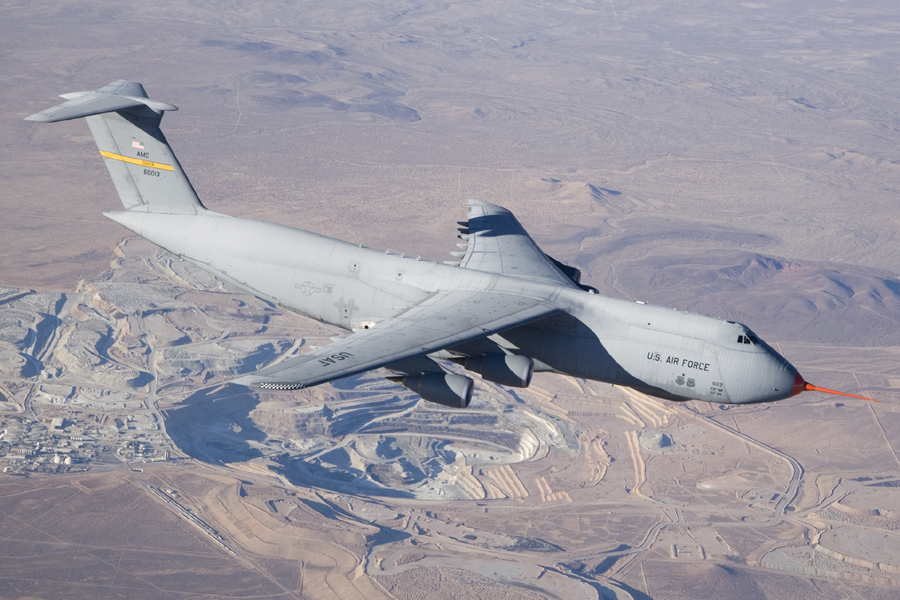
7/30/2007 - EDWARDS AIR FORCE BASE, Calif. -- The Combined Test Force for the C-5 modernization program concluded a series of testing on July 23. The CTF performed tests to determine the aircraft's climb performance as part of the C-5M's Reliability Enhancement and Re-engining Program. The CTF consists of members with the 418th Flight Test Squadron Detachment 4, a geographically separated unit located at the Lockheed Martin plant in Marietta, Ga. "We're roughly halfway through our test program," said Wade Smith, 418th FLTS, Det. 4 lead flight test engineer. One of the types of testing the team performed is called "sawtooth testing," said Tech. Sgt. Vernon Lewis, lead electro-environmental test manager for the detachment. "It's called 'sawtooth testing' because when you look at a graph of the climbs and descents it looks like a sawtooth," Sergeant Lewis said. "On one flight, the testers were flying anywhere from 8,000 to 13,000 feet. We were gathering data on the thrust and drag characteristics of the aircraft with the new engines." The team conducted the first in-flight deployment of the C-5M's thrust reversers in mid-July. "Unlike commercial aircraft, which only use their reversers on the ground, we use the two inboard thrust reversers in flight as a high drag device if we need to decelerate or descend quickly," Mr. Smith said. The new engines have performed very well in tests, Mr. Smith said. "We have no problems with the engines," he said. "The increased thrust has been very impressive. We operated the C-5M at higher altitudes than the legacy C-5 could reach." The team recently used full thrust for the first time during take-offs, Mr. Smith said. "We consistently took off at approximately 810,000 pounds, which is more than the standard operating weight of 769,000 pounds for the legacy C-5s in the fleet," he said. "We've been taking off with no problems at all. The legacy C-5 with the old engines could not have taken off in these circumstances." The replacement of the old engines with the new CF6 model has removed the distinctive sound of an approaching C-5, Mr. Smith said. "The C-5 is a notoriously loud airplane," Mr. Smith said. "We have had problems with noise complaints. The new engines will allow us to easily stay within acceptable requirements." The CF6 engines enable the C-5M to take off and land on shorter runways, which is important to the warfighter, Sergeant Lewis said. These new engines also save fuel. With more powerful engines and lower fuel consumption, the C-5 can fly farther at heavier weights into places it couldn't before. "With this aircraft, there is a constant trade off between cargo and fuel payload," Mr. Smith said. "Now, we can carry cargo and put more fuel on the aircraft and know that we have the performance to take off in high-density, high-altitude conditions even if we lose an engine." The C-5M should also provide better performance in global air traffic management airspaces, Mr. Smith said. A fully-loaded legacy C-5B has a difficult time operating in certain GATM airspaces because the aircraft can't climb quickly enough. "One of our key performance parameters with the new engines is to demonstrate the C-5M's ability to climb into GATM airspace with a full combat load within a certain amount of time," he said. "Our initial results show we should be able to meet that requirement. That testing will take place in the fall." One more C-5 has been approved for low-rate initial production to start the production line, Mr. Smith said. However, the Air Mobility Command has not yet decided on funding to convert the rest of the C-5 fleet. If funding is provided, the plan is to convert all 49 of the remaining C-5B models and the two C-5C models that were modified for space cargo, he said. Whether or not the remaining C-5A models will be modified is still up in the air. Edwards was the base chosen for the tests because of its smooth air, good weather and long runway, Mr. Smith said. "The airspace here also allows us to do unrestricted climbs, which is what we really need for this type of testing," he said. Another reason Edwards is a good test location is the generally clear weather needed for the 23-foot long orange nose boom the C-5M carries for tests, Mr. Smith said. "The boom carries very precise air-data equipment for measuring speed, altitude and temperature," he said. "We need that data for all performance testing. We can't fly through clouds or any visible moisture with the test boom. If water gets in the boom, it can freeze and damage the instrumentation in it." Two C-5M's are scheduled to return to Edwards at the end of August and stay through November, Mr. Smith said. They will be used for conducting minimum control ground speed and field performance data tests. "The warfighter will get a lot more flexibility with this aircraft," he said. "The main focus of the program is reliability. If these modifications work out the way they should, that will be the greatest impact to the warfighter." Source: USAF by Senior Airman Jason Hernandez |
|
|
All original content Copyright © 2006 - 2008 The North Spin