










|
Growler Zaps Through Initial
Testing
|
|
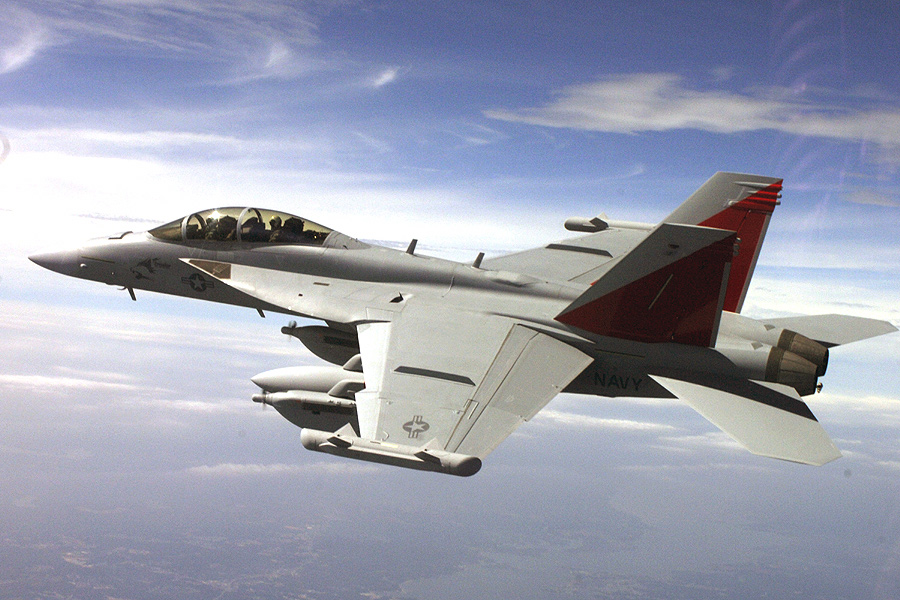
4/20/2007 - The Navy’s next-generation electronic warfare aircraft has completed the first phase of test and evaluation, and is set to receive hardware and a final build of software that will make it the world’s most capable aircraft of its kind. The EA-18G Growler has finished an ambitious regimen of flight tests since the arrival of Growler test prototype aircraft EA-2 at Naval Air Station Patuxent River, Md. in late November. The team has implemented a new concept of Integrated Test and Evaluation, concurrently completing both system developmental testing and an independent fleet operational assessment within the first 90 days of flight test. Feedback from operational testers is being immediately incorporated into development of the platform and its systems, which will provide a more capable system to the fleet and, in this case, is shortening the development time needed to deliver the aircraft to the fleet. The EA-18G mission systems test team and aircrew from Flight Test and Evaluation Squadrons VX-23 at Pax River, VX-31 and VX-9 at NAWS China Lake, Calif., and Boeing contractor crews have had a single Growler flying up to four times a week to complete the rigorous test schedule. “As of late March, the Growler mission systems team had completed over 100 hours of flight test. We have done more in the first 80 days than I could ever have imagined. In this case we were able to simultaneously complete both a developmental and operational assessment of the system on the East and West coast using the same aircraft, ranges, flight test data, and team of expertly qualified aircrew.” said Cmdr. Jaime Engdahl,EA-18G test and evaluation lead. “We have accomplished everything that needed to be done and more, and what we’ve learned about the aircraft is simply great.” As one example of its success, the program schedule required the Growler to radiate ALQ-99 pods in a Pax River chamber by the end of February. As a result of early software delivery and solid system performance, the EA-18G test team was able to demonstrate this jamming capability in December, radiate jammers in-flight by the end of January, and had ensured jamming functions did not interfere with safe operation of any on-board systems across the entire ALQ-99 radiation spectrum in the process. Testers are using the first two Growler prototype aircraft. EA-1, which Boeing delivered to the Navy on Sept. 22, 2006, is at Pax River and recently completed five months of chamber testing. EA-2, which arrived in late November, is currently undergoing range testing at China Lake. Even before the first Growlers arrived, VX-23 aviators had completed five months of aeromechanical flight tests on three Super Hornets configured as Growlers. The Growlers are set to receive their final software and hardware build in July, which Engdahl calls the last major challenge through the end of test and evaluation. Software build 2.0 will fix deficiencies discovered in the first software tape, which also includes 36 percent more software functionality as well as rolling in capabilities for Communications Countermeasures and Multi-mission Advanced Tactical Terminal systems hardware. The pace of testing since December has provided the team an extra two months to incorporate fixes into the upcoming software push. Engdahl says the success of testing is a result of what Naval Air Systems Command’s Super Hornet program (PMA 265) has been declaring all along – the Growler is a low-risk development program that combines two proven systems into one capable design: EA-18G matches a Super Hornet Block II aircraft with the ALQ-218(v)2, a modified version of Improved Capabilities III systems currently being used in combat operations by EA-6B Prowler aircraft and which will be integrated on the Growler. Crews deploying the ICAP III suite have lauded it as a vast leap forward in electronic warfare capabilities. “We’ve been able to borrow a lot of the expertise we already had in the Super Hornet, EA-6B and ICAP III programs. This gives us a huge advantage over starting from scratch,” Engdahl said. “When we climbed into the Growler’s cockpit and turned the system on, or selected ‘Master Radiate’ for the first time, everything worked. It is rare to find a complex airborne system that works the first time.” The program has sought to maximize commonality across the F/A-18E, F, and EA-18G aircraft. This is intended to ease carrier maintenance and reduce total life-cycle costs for the aircraft. The Growler cockpit shares almost complete commonality with the Super Hornet. The program will reach the important Milestone C decision in April, where the procurement decision will be made for eight additional low –rate production airborne electronic attack (AEA) systems. The Navy currently plans to purchase a total of 84 Growlers. Four EA-18Gs are currently in production and will be used for operational evaluation in the fall of 2008. Initial Operational Capability for the EA-18G is expected a year later at Whidbey Island, Wash, where the Navy’s current EA-6B squadrons are based. “The way things have gone so far, we are looking at being able to provide a very capable electronic warfare platform to the fleet on an unbelievably fast schedule and, of course, that makes us very proud.” said Engdahl. “With our number one goal in mind - delivering the right capabilities on time and on cost - I've given our tactical aircraft programs a mandate to use best-business practices to develop the force needed to ensure Navy and Marine Corps air dominance. The Growler example represents one more success in our effort to provide the warfighter with the most advanced capabilities,” said Rear Adm. Pete Williams, Program Executive Officer for Tactical Aircraft, who oversees the work of PMA 265. Source: USN Press Release by Chuck Wagner |
|
|
All original content Copyright © 2006 - 2008 The North Spin