










|
USN MH-60S ‘Armed Helo’ Completes
Developmental Test
|
|
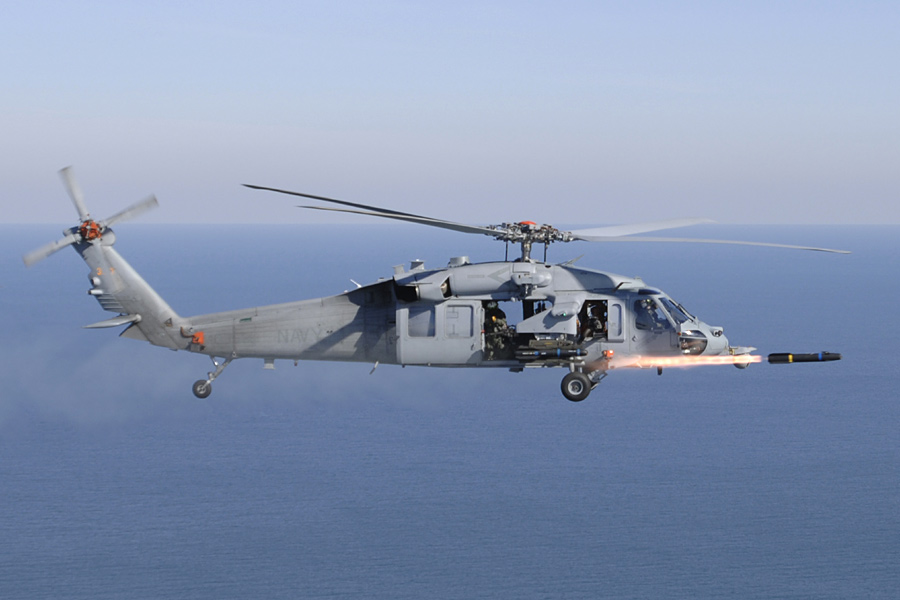
2/6/2007 - NAVAIR Patuxent River, MD – Navy MH-60S Seahawk testers here achieved a double milestone as they completed developmental testing of the “Armed Helo” mission kit with first-time Hellfire air-to-ground missile shots from the aircraft January 30. The testing, which started in March, 2006 and tallied more than 260 flight test hours, included firing missiles from both sides of the aircraft, also a first for the H-60 helicopter. “All other Navy Hawks only have one weapon station on the left side of the aircraft,” explained Randal McKissack, the MH-60R/S common weapon integrated program team lead here. “Having a weapon station on the right side doubles the firing/weapon capability of the aircraft from four to eight missiles and increases the future flexibility of both carrier and expeditionary strike group commanders.” Testers were pleased with the helicopter’s ability to fire and hit the target with all of its missiles on the first try. “Armed Helo is the first helicopter test program to successfully execute all of its Hellfire missile shots since 1998 when the HH-60H successfully completed six out of six shots,” said Kevin Ransford, MH-60S lead test engineer at Air Test and Evaluation Squadron 21 here. “The Armed Helicopter Weapon System block upgrade is a key feature of the MH-60S spiral development effort,” McKissack added. “It will provide future expeditionary strike group commanders with robust capability in the areas of organic combat search and rescue, maritime interdiction operations, surface warfare and carrier plane guard, and search and rescue.” During Armed Helo developmental testing, an HX-21 crew led by Armed Helo Project Officer Lt. Cmdr. Rob Gallagher used three MH-60S test aircraft to test the GAU-21 .50 caliber and M240 7.62mm machine guns in addition to the AGM-114 Hellfire air-to-ground missile, according to McKissack. Other major systems integrated with the MH-60S include the AAS-44C Multi-Spectral Targeting System, the APR-39AV(2) Radar Signals Detecting Set, the AAR-47V(2) Missile Warning System, the ALE-47 Countermeasures Dispensing System, the ALQ-144V(6) Infrared Countermeasures Set and a Digital Map System. Although complete with developmental test, the test team has a training period to complete before starting operational evaluation – the last step before fleet introduction of the capability. The MH-60S multi-mission helicopter shares approximately 85 percent commonality with the MH-60R, including the Lockheed Martin-integrated “common cockpit,” and will replace HH-60H Seahawk helicopters currently in use as part of the U.S. Navy’s “Helicopter Master Plan” which will improve logistical efficiency by reducing six fielded helicopter platforms to two. Approximately 270 MH-60S Seahawks are expected to be delivered to the Navy by 2015. To date, 77 MH-60S aircraft have been delivered to nine fleet squadrons. Source: USN Press Release by John Milliman, PEO(A) Public Affairs |
|
|
All original content Copyright © 2006 - 2008 The North Spin